

Table of Content
- Why Ranking in Dubai Does Nothing for You in Abu Dhabi
- The Trade Licence Problem Most Businesses Miss
- One Google Business Profile Per Branch, No Exceptions
- Location Pages That Google Does Not Flag as Duplicates
- NAP and Citations Across UAE Directories
- Reviews and Local Links, Branch by Branch
- Getting Recommended by AI Search in the UAE
- Track Every Branch Like a Separate Business
- Conclusion
- Frequently Asked Questions (FAQs)
Growing a business in an ecosystem as competitive as the UAE is tough. It is one of the fastest-growing economies in the world, and non-oil sectors now account for the large majority of its GDP. AI startups, IT companies, consultancy firms, import and export businesses, and finance companies are leading that growth.
To beat the competition, you need to grow your business effectively, and one of the best ways to do so is opening new branches and boosting your online visibility. This is where multi-location SEO in the UAE can really help a business. SEO (Search Engine Optimisation) strategies are implemented to improve the online visibility of a business. Traditionally, they are made with a global audience in mind. But if a business wants to target local customers effectively, they need to implement local SEO in the UAE, which is why many brands partner with the best SEO company in Dubai to handle it properly from the start.
Managing and ranking a multi-location business in the UAE is not an easy feat and differs significantly from ranking with traditional SEO techniques. In the following blog, we are going to go into detail about how you can do that. Let’s begin.
Why Ranking in Dubai Does Nothing for You in Abu Dhabi
Organic rankings and local rankings run on different systems, and most businesses only optimise the first one.
Your organic rankings are national. A page that ranks for "management consultancy UAE" ranks the same whether the searcher is in Deira or Al Ain. Your local rankings are not. When someone searches "management consultancy near me" or "accountant in Sharjah", Google builds the map pack from three inputs: relevance, prominence and proximity. Proximity is measured from the searcher to your verified physical address. There is no version of this where a Dubai address wins a search made in Khalifa City.
This is why domain authority feels like it stops working the moment you expand. Your Dubai branch may have five years of reviews, dozens of citations and a page that ranks nationally. Your Abu Dhabi branch inherits the brand name and nothing else. In local search it is a new business.
The practical consequence is that a three-branch business is running three local SEO campaigns, not one. Dubai, Abu Dhabi and Sharjah each need a separate Google Business Profile, a separate location page, a separate citation set, a separate review stream and separate local links. Shared brand, separate signals.
The tough part is not creating the profiles. It is creating them without recycling the same content across all three, because that is where most businesses undo their own work.
The Trade Licence Problem Most Businesses Miss
There is a licensing reality behind this that businesses new to the UAE often miss. Each emirate issues its own trade licence through its own authority, so a Dubai licence does not authorise you to operate a branch in Abu Dhabi. To open a genuine branch in another emirate, you register with that emirate's economic department or the relevant free zone authority and receive a separate licence tied to a separate address.
Why does this matter for SEO? Because Google wants proof that a real, staffed office sits at the address you have claimed. If a profile gets suspended and you have to appeal, the paperwork you will be asked for is the emirate trade licence, the tenancy contract, and a recent utility bill. No licence for that emirate, no appeal.
We see the same mistake all the time. A company rents a mailbox at a business centre, creates a profile against that address, and gets verified without any trouble at all. Months go by. Then a competitor files a redressal request, Google takes a second look, and the listing is gone. Winning it back is far harder than setting it up was. Get the licence sorted before you touch the profile.
One Google Business Profile Per Branch, No Exceptions
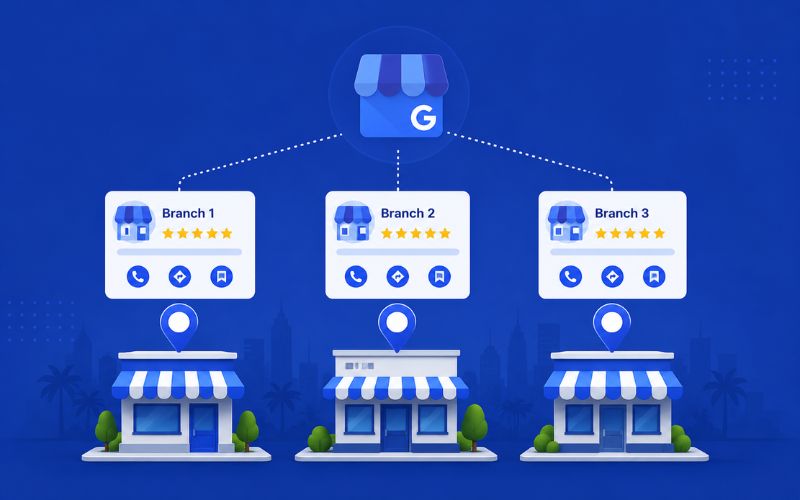
Google has strict guidelines regarding Google Business Profiles. It states that every physical location of a business must have its own separate GBP. This means every branch should have its own verification, NAP data, photos, reviews, and management. Google Business Profile lets you manage every branch from one account, and once you pass ten locations you can group them and upload or update them in bulk through a spreadsheet rather than editing each profile by hand.
The real challenge in managing multiple Google Business Profiles in the UAE is maintaining brand consistency and at the same time ensuring that every profile is unique as well as relevant. You would need to have a consistent name format across the branches, have a unique description that is relevant to that specific neighbourhood, have location-specific photos, and location-specific hours. You would also need a location-specific strategy to manage reviews. Positive reviews from one location would not automatically push your other locations to the top.
Location Pages That Google Does Not Flag as Duplicates
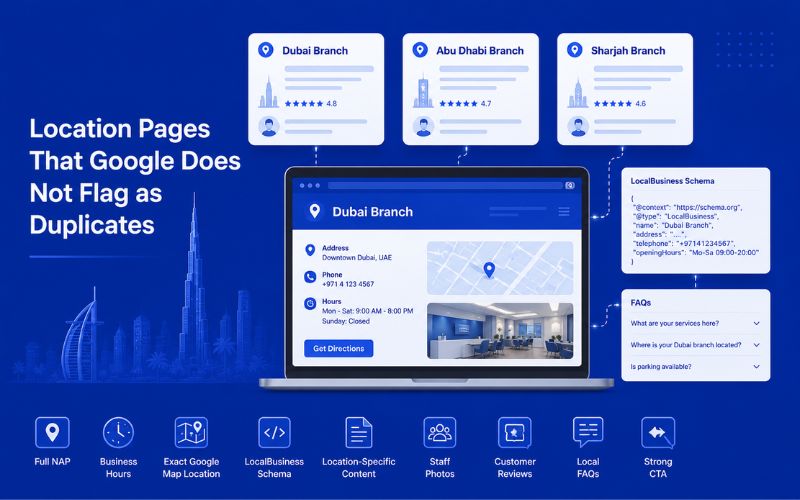
You need to have different webpages for each branch location of your business. Keep in mind that every location page must be unique, relevant, and provide genuine information instead of just following a fixed template. The details should include: full NAP, business hours, exact Google Map location, LocalBusiness schema markup, location-specific content, location-specific staff photos, location-specific customer reviews, local FAQs, and CTA.
It is important that all the location pages do not have almost identical information. Many businesses just copy and paste the same descriptions and About Us section across all the location pages. Google treats those pages as near-duplicates and picks one to rank while filtering the rest out of results. The knock-on effect matters more than the pages themselves: your Google Business Profile relies on its linked location page for relevance signals, so when that page is filtered, the profile loses the on-site support it needs to compete in the local pack. There is no official word count, but in practice a location page needs enough genuinely local substance to stand on its own, which usually lands somewhere between 400 and 700 words once you include neighbourhood detail, parking and directions, branch-specific services and local FAQs.
When Your Own Pages Compete Against Each Other
Duplicate content is the obvious risk. Keyword cannibalisation is the quieter one, and it usually shows up after you have done the work.
It happens when several of your pages chase the same query. A homepage optimised for "SEO services Dubai", a Dubai location page targeting "SEO services Dubai", and a blog post on "SEO services in Dubai explained" leave Google choosing between three of your own URLs. It rotates between them, splits the internal link equity three ways, and none of them ranks as well as one consolidated page would have.
In multi-location setups this shows up in two predictable places:
Head office versus branch page: Your homepage and your Dubai location page both target the city you are headquartered in. Fix: let the homepage own the brand and service terms with no city modifier, and let the Dubai location page own "service + Dubai".
Emirate versus neighbourhood: A Dubai page and a Business Bay page both target "accountant Dubai". Fix: the emirate page targets the emirate, the neighbourhood page targets the neighbourhood and the landmarks around it, and the neighbourhood page links up to the emirate page.
The diagnostic takes five minutes. In Google Search Console, open Performance, filter by a target query, then switch to the Pages tab. If more than one URL picks up impressions for that query, and the URL Google shows changes over time, you have cannibalisation. Consolidate, redirect the weaker page, or re-target it around a genuinely different query.
Map every page to one primary query before you build. Retrofitting this across twelve location pages is far more expensive than planning it once.
NAP and Citations Across UAE Directories
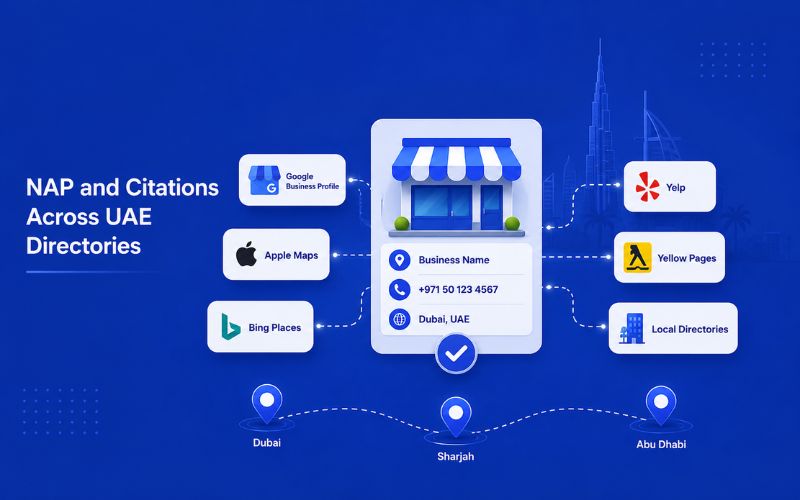
Search engines cross-check your business details against directory listings, mapping platforms, and data aggregators. The set that matters in the UAE is different from the US and UK lists that most SEO guides recycle.
Core platforms for any UAE business:
- Google Business Profile
- Apple Business Connect, which feeds Apple Maps
- Bing Places
- Yellow Pages UAE
- Connect.ae
- Your emirate's chamber of commerce member listing, such as the Dubai Chamber directory
Vertical directories, chosen by sector:
- Food and beverage: Talabat, Deliveroo, Noon Food, Careem, plus Zomato for restaurant discovery listings, though Zomato exited UAE food delivery in 2022
- Real estate: Bayut, Property Finder, dubizzle
- Healthcare: Okadoc and similar booking platforms
- Home and automotive services: dubizzle, ServiceMarket
Yelp appears on nearly every citation checklist but carries very little weight in the UAE, so it is not worth prioritising.
NAP consistency across this set is one of the major ranking factors for a business. Even a minor spelling difference across two directories can lead a search engine to treat them as two separate businesses, which weakens both listings. Clean, consistent NAP data helps search algorithms and AI search engines match scattered information back to the same business.
Every branch location needs its own separate citation footprint. Citations for a branch in Sharjah would not help the branch located in Abu Dhabi. You need to build a citation set for each branch individually. Note that the data aggregator model most SEO guides recommend, Foursquare, Data Axle and similar, barely feeds UAE local search. Here you submit directly: each branch to Google Business Profile, Apple Business Connect, Bing Places, the emirate-level directories and the vertical platforms relevant to your sector. You also need to make sure that the location pages of your website display the location-specific unique NAP and not the common NAP.
Reviews and Local Links, Branch by Branch
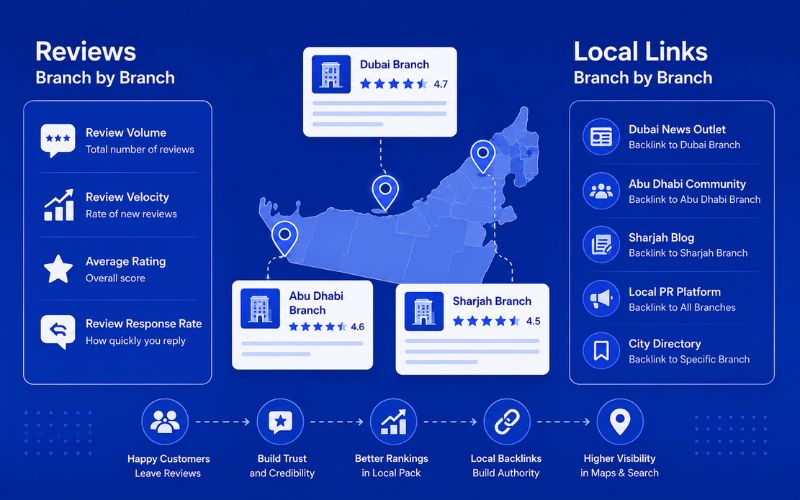
Online customer reviews have become a key factor for search engines to evaluate a certain website or business. Google reads user-generated signals to decide which businesses to surface. Four review-related signals consistently correlate with performance in the local pack and Google Maps:
- Review Volume: The total number of reviews attached to a specific GBP. It establishes customer trust and activity.
- Review Velocity: The rate at which new reviews are posted. A steady flow of weekly reviews signals an active business.
- Average Rating: The overall score of a GBP.
- Review Response Rate: The share of reviews that receive an owner reply. Replying to close to 100 percent of reviews, including the negative ones, is the signal here. Response time matters too, and a reply within 24 to 48 hours is a reasonable working target.
You would also need to add local backlinks for each market. For instance, a link from an Abu Dhabi news outlet will only benefit your Abu Dhabi branch, not your Dubai branch. An effective link-building strategy requires you to identify local PR platforms, news outlets, community websites, and city blogs. The best way to do this is to work with a leading digital marketing agency in Dubai, because local knowledge and established contacts make outreach far easier than cold pitching from outside the market.
Getting Recommended by AI Search in the UAE
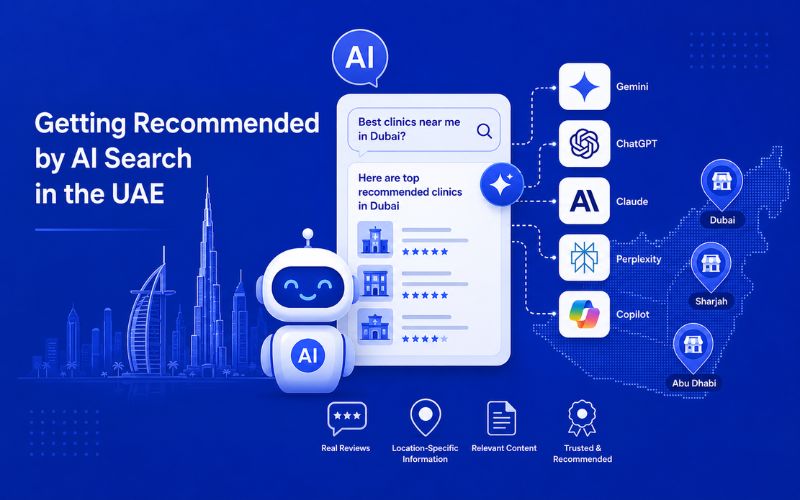
Google still handles the overwhelming majority of searches, but a growing share of research now starts inside an AI assistant, and Google itself increasingly answers local queries with an AI Overview above the map pack. That changes what you are optimising for. Traditional search matches a query to a page. AI search reads across your profile, your location page, your citations and your reviews, builds a picture of what your branch actually is, and then decides whether to name you in the answer. You are no longer competing for a blue link. You are competing to be the business the model chooses to mention.
When a user asks an AI assistant for recommendations, the algorithm parses all the publicly available online reviews to get a thorough understanding of the reputation of different businesses. This favours specificity over volume. A branch with fifty reviews that repeatedly name the neighbourhood, the service and the staff gives a model far more to work with than a branch with five hundred reviews that all say "great service". The same applies to your own content: an AI assistant asked for "an accountant near Business Bay" needs to find text that connects your firm to Business Bay by name. These reviews are also cited and summarised whenever a user makes “near me” searches.
Local search intent matters a lot for multi-location SEO. If your GBP, location webpages, and backlinks do not cater to it, your business will not be ranked at the top or may not even be ranked at all. Taking care of all those things and managing them regularly is necessary if you want your business to be cited and recommended by AI search engines like Gemini, ChatGPT, Claude, Perplexity, and Copilot. Generative engine optimisation carries its own set of requirements, from entity clarity and structured data to citation-friendly formatting, and ranking in AI search in the UAE means working through those alongside your local signals rather than treating them as separate projects.
Track Every Branch Like a Separate Business
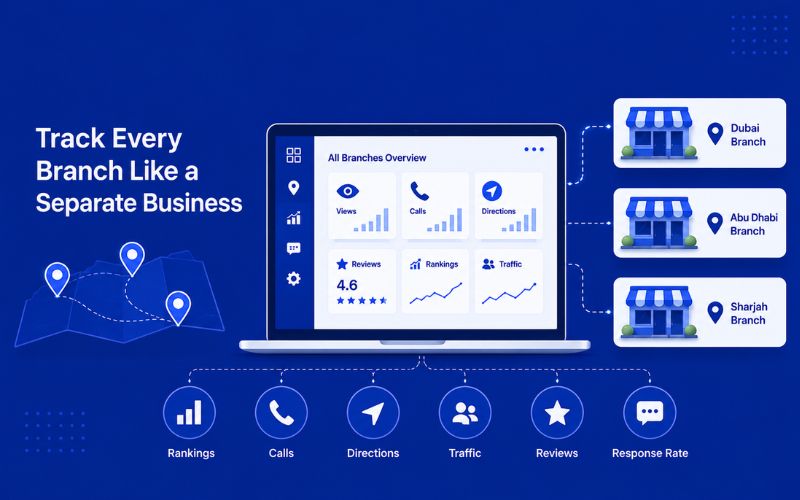
To effectively manage local SEO for multiple locations, you need to operate them from a single platform rather than different ones. The Google Business Profile Manager has a location group feature that is very useful for organising and managing all the different GBPs of your branches. Every branch needs its own scorecard: local pack position, organic rankings, profile views, calls, direction requests, organic traffic, conversions, review count, average rating and response rate. An average across all branches hides the one that is quietly failing, which is exactly the branch you need to find.
Manual work is not very effective when you have to scale. This is where automation and centralised systems come in. They let you manage locations in bulk.
- A page template lets you work with a single structure, dynamic local fields, and pre-filled unique copy.
- You can use the Google Business Profile API to manage and update profiles in bulk. You can also use a third-party platform.
- Keeping a master record, like a spreadsheet, can help you sync NAP details to every directory automatically.
- Implementing helpful schema markups, like LocalBusiness, can help search engines display rich content from your webpage. It boosts your rankings as well.
Internal Linking That Tells Google Your Structure
Internal linking is how you tell Google which of your pages matter and how your branches relate to each other. On a multi-location site it does more work than on almost any other site type, and it is usually the most neglected.
Four rules cover most of it:
Build a locations hub: One page at /locations/ that links to every branch page, linked from your main navigation and your footer. This is the page Google crawls to discover new branches, so a new location page gets found in days rather than weeks.
Link parent to child, not sideways: Emirate page links down to its neighbourhood pages, neighbourhood pages link back up. Do not link every location page to every other location page. A Sharjah branch has no relationship to an Al Ain branch, and a footer stuffed with twelve city links dilutes every one of them.
Use descriptive anchor text: "Our Abu Dhabi office" beats "click here" and beats a bare URL. It also beats keyword-stuffed anchors like "best SEO Abu Dhabi", which look manipulative at scale.
Point service content at the right branch: A blog post about a project delivered in Sharjah should link to the Sharjah location page, not the homepage. This is how topical relevance reaches the branch pages that need it.
Conclusion
If you want to effectively rank in multiple cities, you would need to implement customer-centric SEO strategies, avoid using duplicate content across location pages and GBP, create high-quality localised content, and respond to reviews as soon as possible. Frequently auditing your webpages, GBP, and NAP listings can help you detect duplicate and inconsistent content before it starts affecting your visibility and rankings in the UAE.
At AONE SEO Service, we help businesses strengthen their online presence through technical SEO, content optimisation, and location-level local SEO. By keeping every branch profile, location page, and citation accurate and genuinely local, you build a site structure that performs better in both traditional and AI-powered search results. Our professional SEO services in Dubai cover everything from location page creation to Google Business Profile management across every branch you operate.
Contact us today to discuss your SEO requirements. Call us on +971585641811 or email us at info@aoneseoservice.ae.
FAQs
How long does it take for a new business location to rank in Google Maps?
A new business location can take several weeks to several months to gain visibility in Google Maps. The timeline depends on factors like profile completeness, local competition, reviews, citations, and ongoing local SEO efforts.
Can a business rank in multiple UAE cities without having physical branches?
No. Google prioritises businesses with verified physical locations for local search results. You can target multiple cities through content, but ranking in the local map pack usually requires a genuine physical presence.
Should each UAE branch have its own social media pages?
Not necessarily. Most businesses maintain a single brand account while publishing location-specific updates. However, branches with distinct audiences or frequent local promotions can benefit from dedicated social media profiles.
What types of businesses benefit most from multi-location SEO in the UAE?
Industries such as healthcare, education, retail, hospitality, automotive services, real estate, banking, and professional services often benefit the most because customers usually search for providers close to their current location.
Can franchise businesses use the same multi-location SEO strategy?
Yes, but each franchise location should have unique business information, local content, customer reviews, and Google Business Profile management while maintaining consistent branding across every branch.
What are the biggest mistakes businesses make with multi-location SEO?
Common mistakes include creating duplicate location pages, inconsistent contact details, sharing one Google Business Profile across multiple branches, neglecting customer reviews, and failing to add locally relevant content for each location.
How important are photos for local SEO rankings?
High-quality, regularly updated photos improve customer trust and engagement. Location-specific images of your storefront, staff, products, and services can strengthen your Google Business Profile and help conversions.
How can businesses measure the success of multi-location SEO?
Success can be measured through metrics such as local keyword rankings, Google Business Profile interactions, phone calls, direction requests, website visits, enquiry submissions, and conversions generated from each individual branch.
Is it necessary to update location pages regularly?
Yes. Regularly updating location pages with new photos, business information, promotions, FAQs, or customer testimonials signals that the business is active and helps keep information accurate for users and search engines.
Can AI-powered search change how multi-location businesses are discovered?
Yes. AI-powered search increasingly relies on accurate business information, local relevance, customer reviews, and authoritative online mentions to recommend businesses. Thus, making consistent optimisation across every location becomes more important than ever.