


Table of Content
- What Is Website Architecture?
- Why Website Architecture Matters for SEO
- Types of Website Architecture
- What Does a Good SEO Site Structure Look Like?
- How to Optimize Your Website Architecture for Better SEO
- Website Architecture Tips for Ecommerce Sites
- Common Website Architecture Mistakes to Avoid
- How to Change Your Site Architecture Without Losing Rankings
- Tools to Audit Your Website Architecture
- Frequently Asked Questions
- Conclusion
Quick Takeaway
- Website architecture helps organize pages, categories, URLs, and internal links for better navigation and SEO.
- A clear website structure makes it easier for search engines to discover and understand important pages.
- Choose the right architecture, such as hierarchical or flat, based on your website's size and purpose.
- Use keyword research, topic clusters, logical page hierarchy, and consistent navigation to organize content.
- Create SEO-friendly URLs, strategic internal links, and breadcrumb navigation to connect related pages.
- Ecommerce websites should manage filters, pagination, and product categories carefully to avoid unnecessary URLs.
- Avoid orphan pages, duplicate URLs, keyword cannibalization, and overly rigid content silos.
- Use tools like Screaming Frog, Semrush, Ahrefs, and Google Search Console to audit website architecture.
- Review your website structure regularly and implement proper 301 redirects when changing URLs.
A website attracts visitors through search engines and marketing campaigns, but converting that traffic becomes difficult when people cannot find what they need. Confusing menus, poorly organized categories and complicated navigation can turn an otherwise useful website into a frustrating experience. DHL’s 2026 E-Commerce Trends Report, which surveyed 29,000 online shoppers across 29 countries, found that 51% of shoppers have abandoned an online purchase because a site was slow or complicated. However, only 36% of businesses see this as a reason their customers leave. That gap shows how easily friction on a website goes unnoticed while it quietly costs sales. Well-planned website architecture for SEO helps businesses organize information logically, makes key pages easier to find, and gives visitors a clearer path to an inquiry or purchase.
What Is Website Architecture?
Website architecture is about how a website’s pages are organized, linked, and presented to users. It includes navigation menus, categories, URLs, and internal links. Understanding it also helps businesses recognize how page organization influences usability and search engine discovery.
Why Website Architecture Matters for SEO
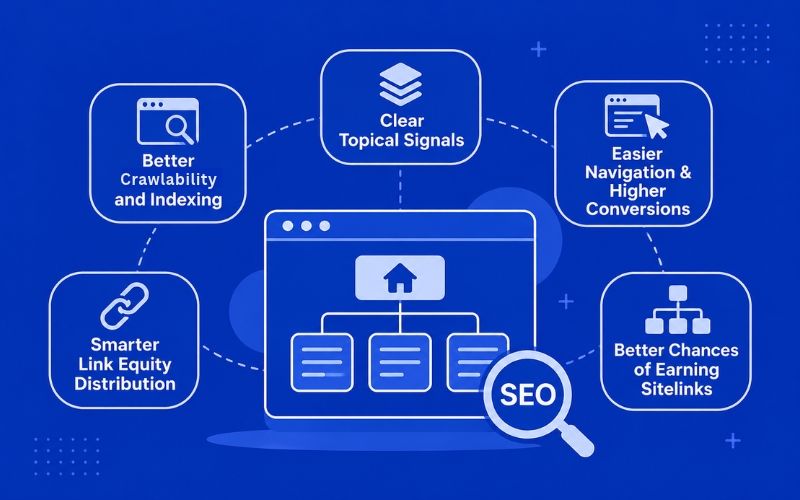
Better Crawlability and Indexing: A good website structure helps search engines discover pages and understand how they relate to one another.
Smarter link equity distribution: The internal linking structure of a website helps distribute link equity across relevant pages, supporting the visibility of important content.
Clear topical signals: Grouping related information helps search engines understand the subjects that the website covers.
Easier navigation and higher conversions: Visitors can find services, products, and contact details without struggling through unrelated pages.
Better chances of earning sitelinks: Clear navigation and meaningful internal links can help Google identify useful pages, although sitelinks are not guaranteed.
A well-planned website structure for SEO supports these goals by connecting important pages and making the site's content easier to understand.
Types of Website Architecture
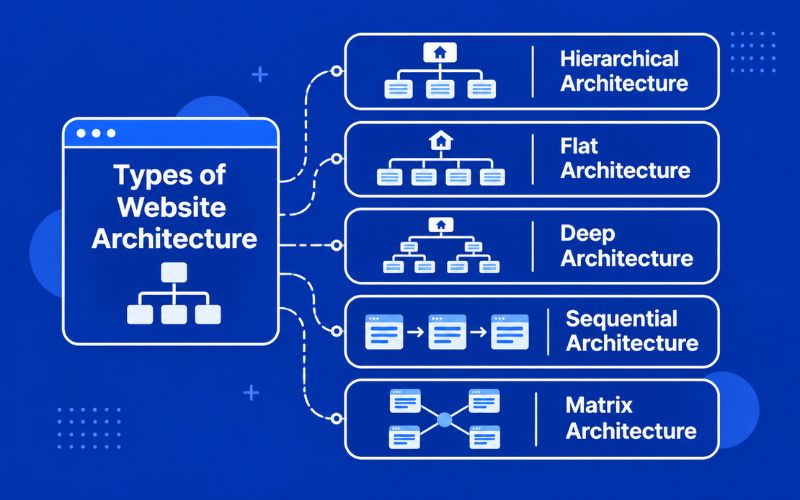
Hierarchical Architecture
Hierarchical architecture means pages follow a website hierarchy, a parent-and-child arrangement that moves from the homepage to categories and individual pages.
This structure works well for business websites, blogs, and ecommerce stores. It is a common approach when developing an SEO site architecture for websites with multiple services or product categories.
Flat Architecture
A flat website architecture keeps important pages close to the homepage. It can improve accessibility, although larger websites may still need multiple category levels.
Deep Architecture
Deep architecture places pages several levels below the homepage. While some complex websites require this arrangement, excessive depth can make important content harder to discover.
Sequential Architecture
Visitors follow a defined sequence, such as moving through an application, registration process, or checkout journey. It works best when steps need to happen in a particular order.
Matrix Architecture
Matrix architecture allows visitors to explore content by topic, category, or filter. It's useful for resource libraries and large product catalogs where people may look for the same information in different ways.
What Does a Good SEO Site Structure Look Like?
A good SEO site structure groups related pages logically without making navigation complicated. For example, a digital marketing website might have a home page, service categories, individual service pages, supporting blogs, and a contact page.
The best SEO company in Dubai can help you give every page on your website a clear purpose. Descriptive URLs, consistent navigation, and relevant internal links reinforce the structure and make important information easier to reach. An SEO-friendly website structure should also allow visitors to move between related pages without unnecessary steps.
How to Optimize Your Website Architecture for Better SEO
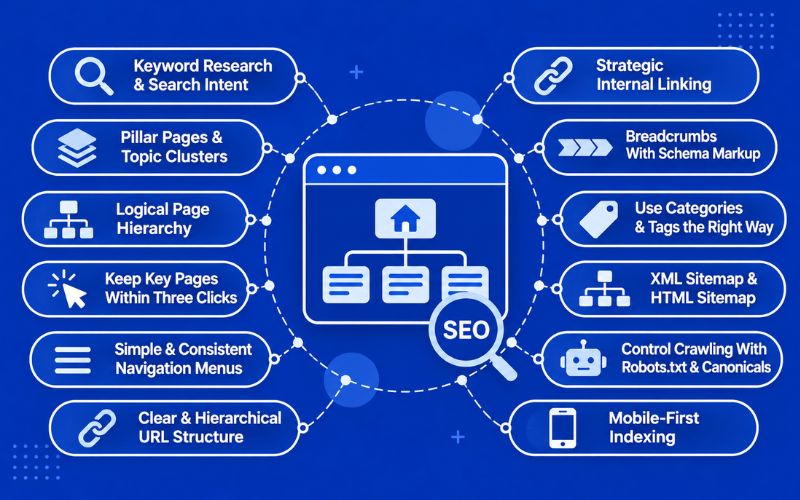
Optimizing website architecture can help businesses organize their website more efficiently. If you are wondering how to optimize website architecture, then consider these factors:
Start With Keyword Research and Search Intent
Identify the terms your audience searches for and understand what they expect to find. Group keywords by search intent rather than creating separate pages for any minor variation.
Group Content Into Pillar Pages and Topic Clusters
Build comprehensive pillar pages around your main topics and link them to relevant supporting articles. This gives readers an easier way to find related resources and explore a subject in more detail.
Build a Logical Page Hierarchy
Organize pages according to their purpose. Keep the main navigation focused on important sections and use subcategories where they can improve navigation.
Keep Important Pages Within Three Clicks
Reaching important content within three clicks is a useful planning guideline, not a strict Google ranking rule. Prioritize accessibility over following an arbitrary number.
Create Simple and Consistent Navigation Menus
Use familiar labels and maintain consistent menus across the website. Avoid overcrowding navigation with too many options.
Use Clear and Hierarchical URL Structure
An SEO-friendly URL structure should be descriptive, concise, and consistent. For example, /services/technical-seo/ communicates the page's subject more clearly than a random string of characters.
Plan a Strategic Internal Linking System
The internal linking structure of a website should connect related pages naturally. Link supporting articles to relevant service pages and use descriptive anchor text that explains what readers will find.
Add Breadcrumb Navigation With Schema Markup
Breadcrumbs show visitors where a page sits within the website. Adding valid BreadcrumbList structured data helps search engines understand the breadcrumb trail, although enhanced search appearances are not guaranteed. Effective breadcrumb navigation SEO practices can support clearer navigation and help communicate the relationship between a page and its parent categories.
Use Categories and Tags the Right Way
Categories organize content into broad subjects, while tags identify specific themes. Avoid creating numerous overlapping archive pages that offer little additional value.
Submit an XML Sitemap and Keep an HTML Sitemap
An XML sitemap helps search engines find important URLs, while an HTML sitemap offers visitors another way to explore the website. And neither of them replaces proper internal linking.
Control Crawling With Robots.txt and Canonical Tags
Use robots.txt to control crawler access where appropriate and canonical tags to indicate preferred URL versions. Keep in mind that blocking a page in robots.txt does not necessarily prevent it from appearing in search results.
Design for Mobile-First Indexing
Google prioritizes the mobile version of website content for indexing. Keep essential content, navigation, and internal links accessible across devices.
Using these practical site architecture best practices will help your business be more organized and user-friendly.
Website Architecture Tips for Ecommerce Sites

Ecommerce websites need additional planning because product variations and filters can generate numerous URLs. A business can use these website architecture tips:
- Faceted navigation: Manage filter combinations carefully to prevent unnecessary URL variations from consuming crawl resources.
- Pagination: Provide crawlable links between product listing pages so users and search engines can discover additional products.
- Mega menus: Group products into understandable categories without overwhelming visitors with too many choices.
Professional SEO services in Dubai can provide you with a well-planned site structure, which helps businesses organize large inventories while keeping important products and categories accessible.
Common Website Architecture Mistakes to Avoid
- Orphan Pages: Orphan pages have no internal links pointing to them. So you need to add relevant links or reconsider whether the content still serves a useful purpose.
- Duplicate URL Paths: When the same page is accessible through different URLs, search engines may split signals between them. Check for these duplicates and decide whether to keep them, redirect them, or use canonical tags.
- Keyword Cannibalization: If two or more pages cover the same topic, then combine overlapping content or give each page a different focus so they do not compete for the same search terms.
- Silos That Are Too Rigid: Strict content silos can prevent useful connections between related topics. Maintain clear categories while allowing relevant cross-links.
How to Change Your Site Architecture Without Losing Rankings
First, create a content inventory that covers all the URLs, organic traffic, backlinks, and indexing status. Map the structure before moving pages or combining content. And when the URLs change, implement 301 redirects to their closest destinations. Update all the internal links, canonical tags, and XML sitemaps, then test the website before launch. After implementation, monitor indexing, crawl errors, organic traffic, and important landing pages through Google Search Console.
Tools to Audit Your Website Architecture

Several tools can help you identify structural problems and technical issues:
- Screaming Frog: Crawls pages to identify broken links, redirect chains, and crawl depth.
- Semrush Site Audit: Highlights technical SEO issues and internal linking problems.
- Ahrefs: Helps examine backlinks, internal links, and potential technical issues.
- Google Search Console: Provides information about indexing, search performance, and URL-related problems.
If you want to check website SEO issues, start with navigation, crawlability, and internal links. These tools also flag on-page and technical problems that can hold your website back in search results. You can check a website’s SEO score using an auditing tool, but remember that an audit score is a diagnostic indicator rather than a direct measure of ranking potential.
Frequently Asked Questions
1. What is website architecture in SEO?
Website architecture is how you organize the pages, categories, URLs, navigation, and internal links.
2. What is the ideal click depth for SEO?
Three or fewer clicks is the target for important pages, but it is not a strict ranking requirement. The priority should be making valuable content accessible.
3. Is a flat or hierarchical site structure better for SEO?
Neither is objectively better. A flat structure keeps important pages accessible, and a hierarchical structure organizes a bigger website more clearly.
4. How does internal linking support site architecture?
Internal links connect related pages, help search engines discover content, and guide visitors toward relevant information.
5. Do breadcrumbs help SEO?
Yes. Breadcrumbs show visitors where they are on a website and make it easier to move back to a previous section. They also add internal links to parent pages, which helps search engines understand your site structure. With BreadcrumbList schema, Google may display the breadcrumb trail in search results, although this is not guaranteed.
6. How often should I audit my website architecture?
Review it at least once or twice a year and whenever you introduce major services, reorganize URLs, publish substantial new content, or migrate the website.
Conclusion
A well-planned website structure makes it easier for visitors to find relevant information and helps search engines understand how different pages connect. As your website grows, regularly reviewing its architecture can help identify structural issues, improve navigation, and maintain a strong SEO foundation. When comparing the best digital marketing company in Dubai, consider its approach to technical SEO, website structure, and long-term organic growth rather than rankings alone.
At AONE SEO Service, we help businesses in Dubai create SEO-friendly website structures through website architecture audits, internal linking improvements, URL optimization, and technical SEO. Our approach focuses on making websites easier to navigate, crawl, and understand. As an experienced SEO agency in Dubai, we work on practical improvements that support better search visibility and sustainable organic growth. Contact us today to discuss your website's SEO requirements. Call us on +971585641811 or email us at info@aoneseoservice.ae.